Journal of Hydrology (2022)
Our work · Water resources
Cooling the water we depend on.
A research and engineering program investigating how reflective floating systems may reduce solar heat absorption and evaporative losses on the water bodies that agriculture, industry and cities rely on.
- Applications
- 6
- Core technology
- 1
- Status
- R&D
Freshwater is becoming one of the world's most precious resources.
As global temperatures rise, reservoirs, lakes and water storage systems are losing increasing amounts of water through evaporation. At the same time, growing populations, changing rainfall patterns and more frequent droughts are placing unprecedented pressure on freshwater supplies worldwide. Reducing evaporation is becoming an essential climate adaptation strategy.
Freshwater is one of humanity's most valuable resources, yet it is becoming increasingly vulnerable to climate change.
Warmer air temperatures increase evaporation from reservoirs, lakes and irrigation systems, while changing rainfall patterns are making water supplies less reliable. Longer and more frequent droughts reduce reservoir inflows just as higher temperatures accelerate water loss from exposed water surfaces.
These combined pressures threaten drinking water supplies, agriculture, hydropower generation, ecosystems and economic development across many regions of the world.
Protecting existing freshwater resources is becoming just as important as finding new water supplies.
MEER is developing evaporation suppression technologies that reduce unnecessary water losses while simultaneously helping lower surface temperatures. By reflecting solar radiation before it can be absorbed by the water surface, these systems have the potential to conserve significant quantities of freshwater while also contributing to climate cooling.
339 km³
Estimated water lost from the world's large reservoirs every year through evaporation.
Journal of Hydrology (2022)
+2.0 km³
Global reservoir evaporation losses continue to rise every year as temperatures increase.
53%
More than half of the world's largest lakes and reservoirs have seen declining water storage in recent decades.
3.6B
People already experience water shortages for at least one month every year.
16%
Reservoirs hold only about 5% of global lake storage, yet account for roughly 16% of global lake evaporation.
Why it matters
Water security
Reducing evaporation helps protect drinking water supplies during drought.
Agriculture
More stored water means greater resilience for irrigation and food production.
Climate resilience
Lower water temperatures and reduced evaporation improve long-term reservoir performance.
Planetary cooling
Reflecting sunlight from large water bodies may reduce absorbed solar energy while conserving freshwater.
The challenge is growing
- Climate change
- Higher air temperatures
- Higher evaporation
- Lower reservoir levels
- Greater water scarcity
- Need for evaporation suppression
Learn more
Peer-reviewed research on global evaporation losses and freshwater availability.
Read paper(opens in a new tab)
Nature Communications (2022)
Evaporative Water Loss of 1.42 Million Global Lakes
Nature Reviews Earth & Environment
Global Lake Responses to Climate Change
Nature (2018)
Emerging Trends in Global Freshwater Availability
Conserving water. Cooling the planet.
Instead of allowing valuable freshwater to disappear into the atmosphere, MEER is developing evaporation suppression systems that help conserve water, improve climate resilience and reduce solar heating at the same time.
As climate change accelerates, protecting freshwater resources will become an increasingly important part of adapting to a hotter world.
Please note
Concept and engineering research
MEER is actively researching reflective floating systems designed to sit on water bodies and reduce solar absorption at the surface. This work is in concept development and early engineering research. No system described on this page is available as a product.
For scientific and operational reasons, we do not publish detailed material formulations here. What we do describe is the class of engineered reflective surfaces being explored, the questions they aim to answer, and the environments where they may eventually apply.
[ Why water matters more each year ]
Water bodies are becoming critical infrastructure.
Under climate change, the water bodies humans rely on — for drinking, for growing food, for cooling industry — are hotter, more stressed and more exposed than ever. Reducing the solar load on their surfaces is one of the few passive levers available.
Warming surface water
Open water bodies absorb a large share of the solar energy that falls on them, raising surface temperatures.
Higher evaporation losses
Warmer surfaces evaporate more water — losses that add up rapidly in the hottest, driest regions.
Aquatic ecosystems
Rising water temperatures reduce dissolved oxygen and stress fish, aquaculture and freshwater ecosystems.
Water security
Reservoirs, irrigation ponds and canals are increasingly critical infrastructure in a warming, drying climate.
Industrial cooling
Cooling ponds and process water storage face rising baseline temperatures that reduce their effectiveness.
Agricultural resilience
Water available for irrigation directly determines yields — losses to evaporation are losses to food systems.
[ The physics in one picture ]
Solar absorption drives evaporation.
An uncovered surface absorbs most of the sunlight it receives, warms, and loses water to the air. A reflective floating surface aims to intercept that solar load before the water absorbs it.
[ Floating reflective systems ]
Concept ResearchEngineered reflective surfaces designed to sit on water.
MEER is researching a class of engineered reflective surfaces designed to float on water and return incoming sunlight to the sky rather than allowing it to be absorbed by the water below.
The intended effect is twofold: potentially lower surface water temperatures and reduced evaporation — both of which matter more each year as water becomes scarcer and more thermally stressed.
For scientific and operational reasons we do not publish material compositions here. The class of systems being investigated is highly reflective, designed to be light, deployable at scale and durable in real water environments.
These systems remain firmly in the research and concept development phase. They are not available as products.
Illustrative schematic only
[ Where the research may apply ]
Six water environments, one line of research.
Each environment presents a different engineering problem — very different geometries, biological constraints, wave and wind conditions and operational needs. All of these applications currently sit at the concept research stage.
Concept Research
Reservoirs
Drinking-water and multi-purpose reservoirs, where reducing surface temperature and evaporation losses matters for both quantity and quality.
Relevant technologies
Floating Systems
Concept Research
Irrigation ponds
On-farm storage ponds are among the most exposed and evaporation-critical water bodies in the agricultural system.
Relevant technologies
Floating Systems
Concept Research
Canals
Long, narrow open water systems that lose significant volumes to evaporation across their length. A specialized geometry problem.
Relevant technologies
Floating Systems
Concept Research
Industrial cooling ponds
Ponds used to cool industrial water where rising baseline temperatures reduce their thermal capacity.
Relevant technologies
Floating Systems
Concept Research
Aquaculture
Fish and shellfish ponds where surface water temperature and dissolved oxygen directly affect stock health.
Relevant technologies
Floating Systems
Concept Research
Water treatment systems
Open basins and holding tanks in water treatment plants, where surface warming affects treatment performance.
Relevant technologies
Floating Systems
[ Large open water storage ]
Reflective Reservoir Systems
Anchored rafts of reflective floats, studied as a passive way to cool and conserve stored freshwater.
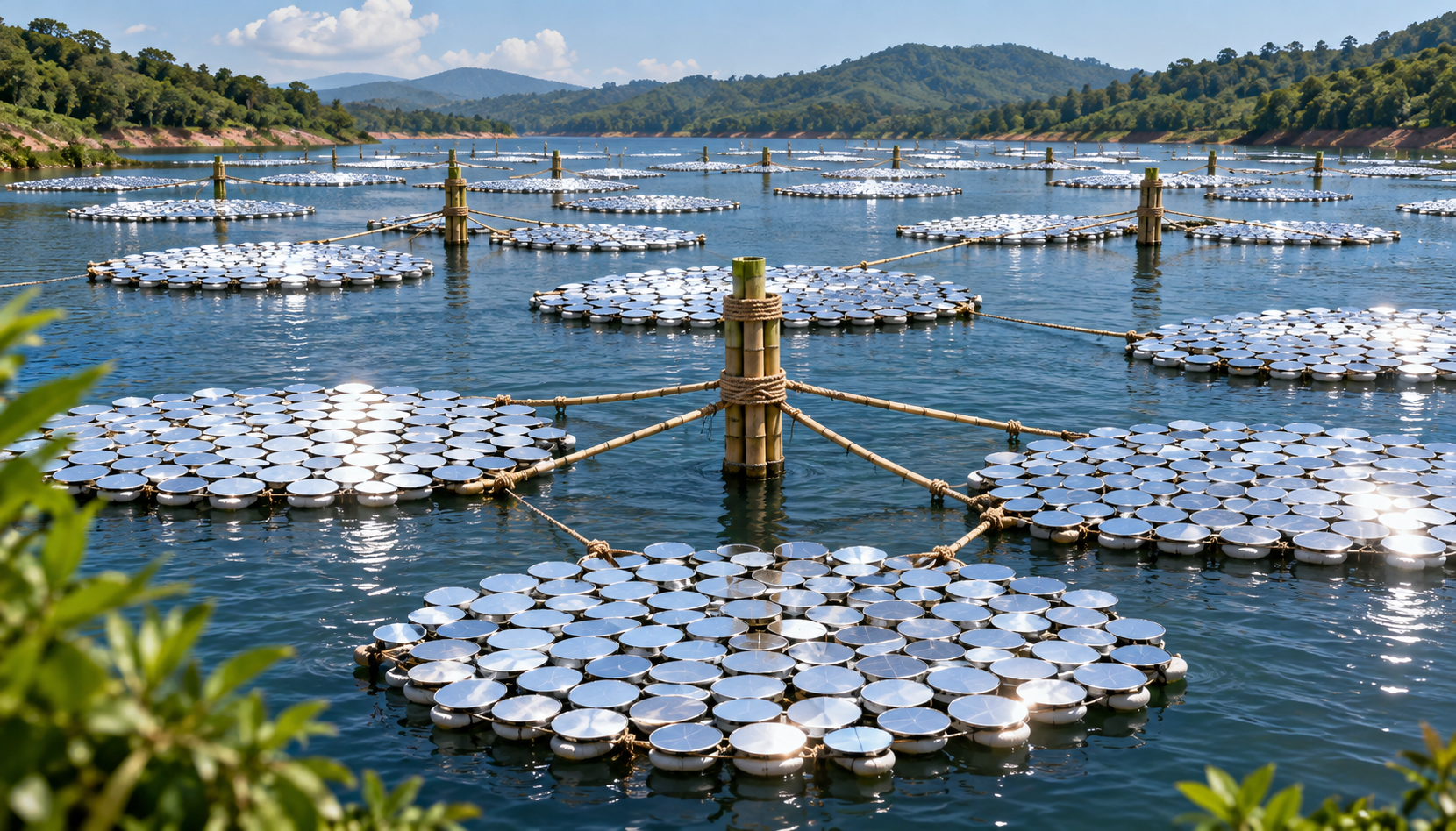
Reservoirs hold the largest exposed surfaces of stored freshwater in most water systems. MEER is exploring whether modular rafts of highly reflective floats could reduce the solar energy absorbed at the surface, lowering water temperature and slowing evaporation.
This remains concept-stage research. Coverage ratios, anchoring in wind and waves, material durability, water quality and ecological effects all need field measurement before any claim can be made about real-world savings.
Returning sunlight at the surface
Floating reflective discs are being studied as a way to send incoming sunlight back before it is absorbed by the stored water body.
Slowing evaporative loss
Partial surface cover over a large reservoir could reduce the volume lost to the air during the hottest months.
Modular rafts, open water between
Discs grouped into anchored rafts leave channels of open water for boats, aeration and wildlife.
Built for wind and wave
Reservoir conditions differ from small ponds — anchoring, fetch and wave loading are open engineering questions.
Future Research
MEER is investigating reflective floating systems for reservoirs as a potential contribution to water security in regions facing hotter, drier conditions. Research is focused on the engineering, ecological and operational questions that would need answering before any deployment at scale.
[ Water storage on the farm ]
Reflective Farm Pond Systems
Helping conserve irrigation water through passive surface cooling technologies.
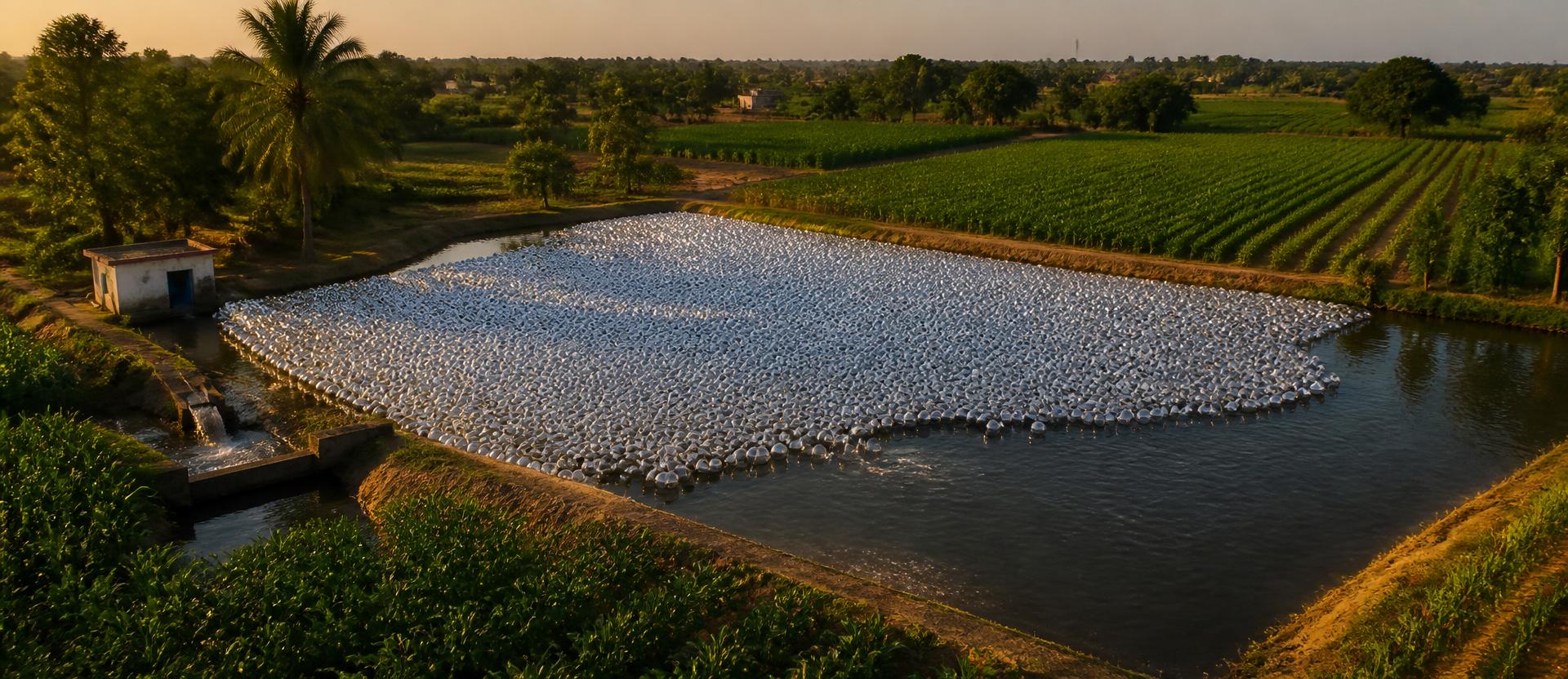
Farm ponds are among the most heat-exposed water bodies in the agricultural system. MEER is researching whether simple floating reflective modules — small, buoyant, highly reflective spheres — could reduce the solar energy absorbed by stored irrigation water and slow the rate at which it is lost to the air.
This is an area of ongoing research rather than an established commercial technology. Coverage ratios, material durability, water-quality effects and real-world evaporation savings all remain open questions that field measurement will need to answer.
Reduced evaporation
Covering part of the surface with floating reflective modules is being studied as a way to limit direct evaporative loss from open storage.
Improved water conservation
Water retained in the pond through the hottest part of the season is water still available for irrigation later in the cycle.
Lower water temperatures
Returning sunlight at the surface reduces the solar energy absorbed by the stored water body beneath.
Passive, no energy input
The modules require no pumps, power or moving parts. They work purely through the optical properties of their surface.
Modular and scalable
Individual floating spheres can be added or removed, allowing coverage to be matched to pond size, access needs and season.
Agricultural resilience
A potential contribution to on-farm water security in regions facing longer, hotter and drier periods.
[ How it works ]
- Incoming sunlight01
- Reflective floating spheres02
- Less solar energy absorbed by the pond03
- Reduced evaporation04
- More water retained for irrigation05
Future Research
MEER is investigating reflective floating modules for agricultural water storage as a potential approach to reducing evaporation and improving water conservation. Research is exploring how reflective surface technologies could contribute to more resilient farming systems in regions increasingly affected by heat and water scarcity.
[ What the research aims to answer ]
The questions that guide this program.
MEER treats each of these as an open research question rather than a solved problem. Progress is expected to come through repeated cycles of laboratory work, engineered prototypes and instrumented field validation.
Reflective performance
How much solar energy can a floating surface reliably return to the sky over its service life?
Water temperature response
What surface and column temperature changes can realistically be achieved under different climates and geometries?
Evaporation reduction
How does the surface behave under wind, waves and partial coverage — and how does that translate to real evaporation savings?
Ecological effects
What are the consequences for dissolved oxygen, light penetration, biology and biodiversity in the water below?
Durability & installation
How do the systems survive wind, storms, ice, UV and biological fouling over years of exposure?
Safety & maintenance
How are the systems deployed, inspected, cleaned and eventually retired without harming the water body?
Materials evolution
How do candidate materials perform in the lab and in the field, and how do we design for continuous improvement?
Scale & cost
How do costs, logistics and installation methods scale from a research pond to a real reservoir?
[ An iterative research program ]
Innovation and deployment research happen in parallel.
Rather than waiting until laboratory work is “finished” before engaging with the real world, MEER develops, tests, measures and refines floating reflective systems through an iterative loop of scientific research and real-world validation.
- Research continues
- Engineering continues
- Materials evolve
- Prototypes improve
- Field validation deepens
- Evidence guides every step
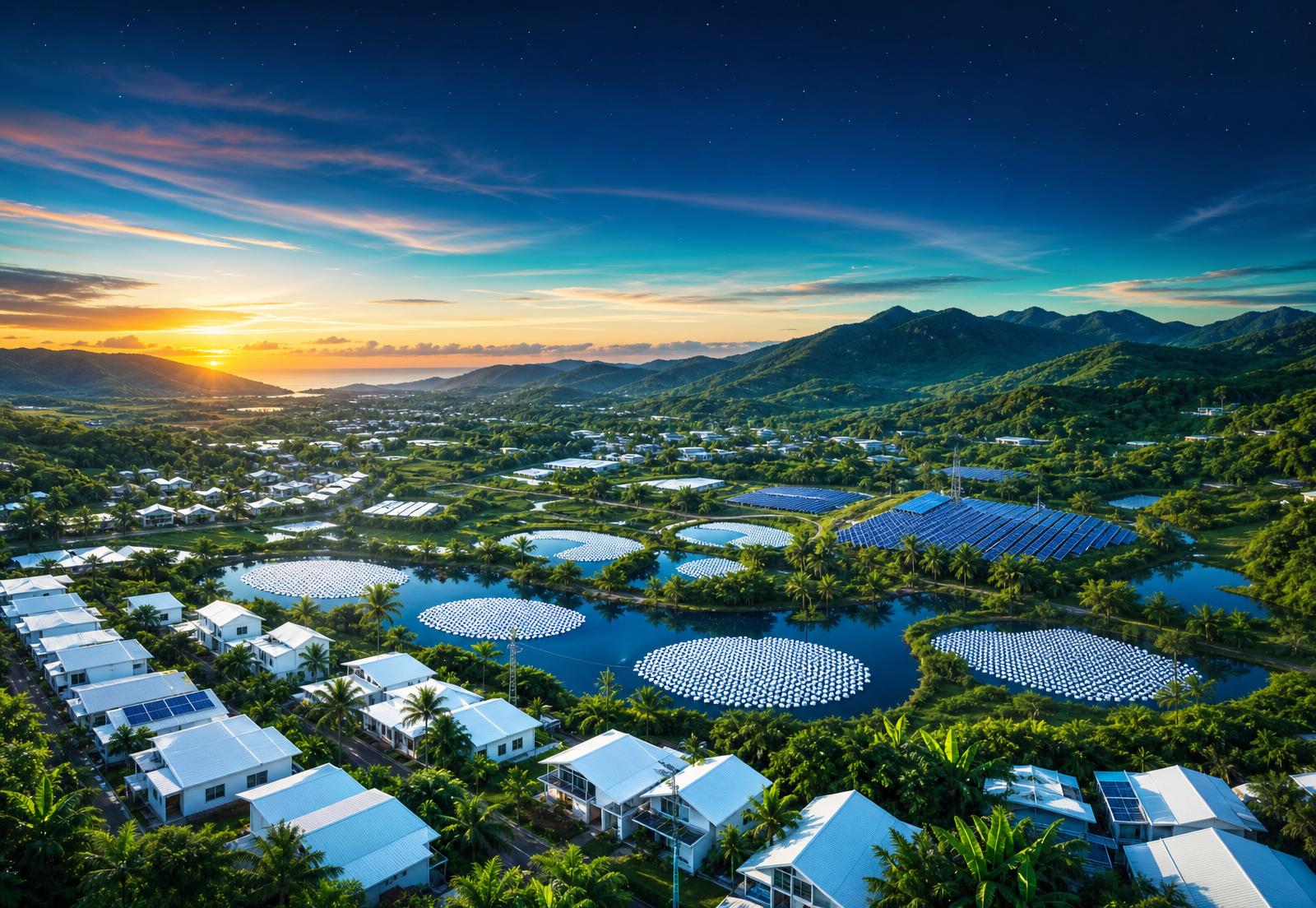
[ Where each technology sits ]
Every application on this page is part of MEER's research and engineering pathway.
We move from concept, through the laboratory, into engineered prototypes and instrumented field trials. Nothing on this page should be read as a finished commercial product unless explicitly described that way elsewhere on the site.
- Stage 01
Concept Research
- Stage 02
Laboratory Development
- Stage 03
Engineering Design
- Stage 04
Prototype Testing
- Stage 05
Field Validation
- Stage 06
Future Deployment
[ Related ]
Continue exploring the research program
Our Technologies
The full portfolio — reflective roofs, PDRC coatings, canopy systems and floating water systems.
ExploreAgriculture
Where irrigation ponds, canals and rural water storage meet MEER's cooling research.
ExploreUnderstanding Albedo
Why the reflectivity of a surface is central to any passive cooling strategy.
ExploreRadiative Cooling
How selective materials emit heat through the atmospheric window into cold space.
ExploreCooling Return on Investment
How different cooling approaches compare on energy in versus cooling delivered.
ExplorePublications
Peer-reviewed and open publications from the MEER research program.
Explore[ Join the research ]
Research the world's water systems will increasingly need.
If you are a water authority, agricultural cooperative, industrial operator or researcher interested in field-testing reflective floating systems, we would like to hear from you.