MEERTalks
Monthly conversations with scientists, innovators and thought leaders exploring practical solutions to climate change, extreme heat and sustainable cooling.
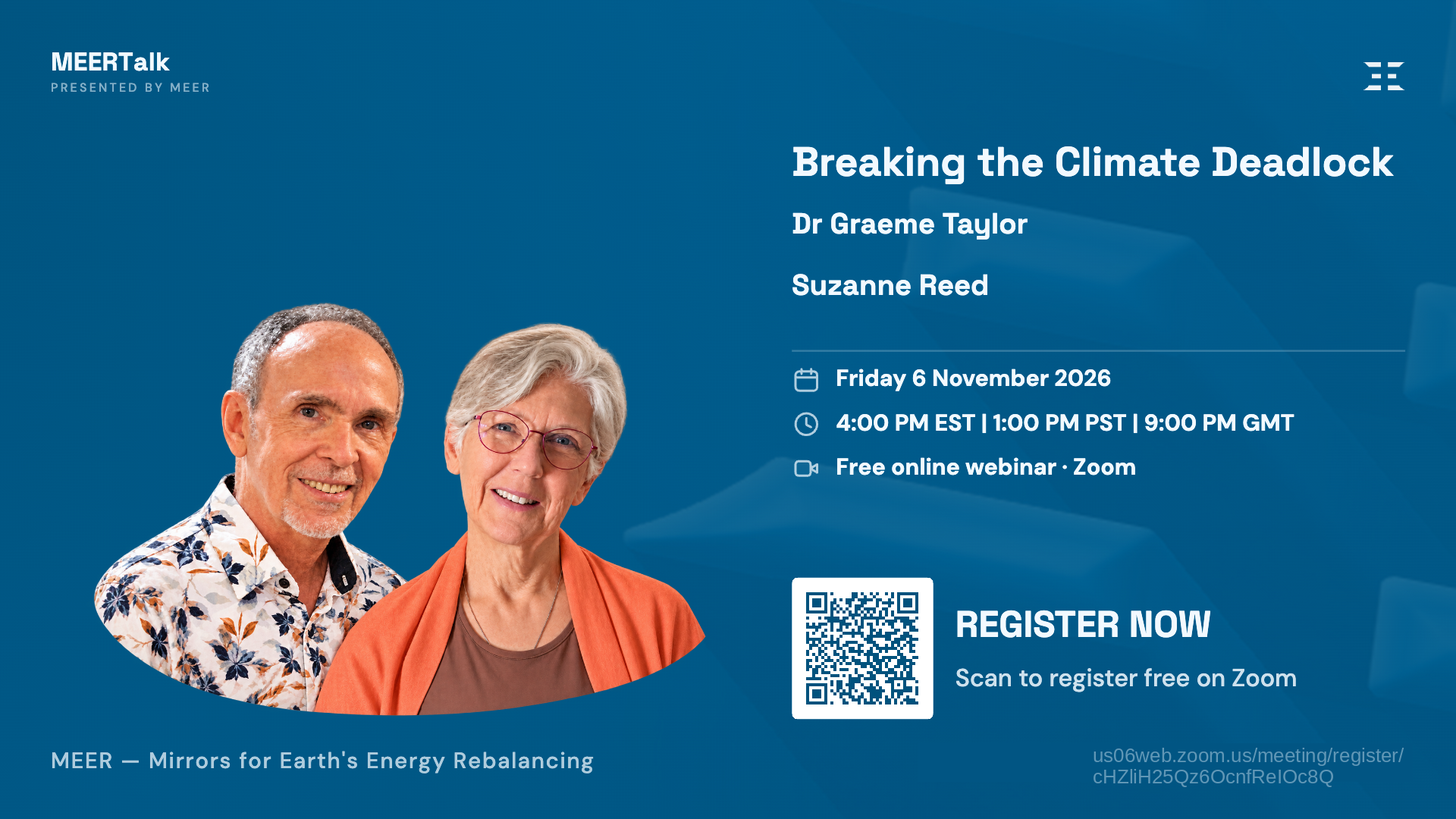
Breaking the Climate Deadlock: A Viable Strategy for a Divided World
Friday 6 November 2026 · 4:00 PM EST · 1:00 PM PST · 9:00 PM GMT · 7:00 AM AEST (Sat 7 Nov) · Free online webinar
他のカレンダーをお使いですか? Outlook カレンダー · カレンダーファイルをダウンロード (.ics)
Climate risks are accelerating, yet the transition away from fossil fuels remains slow. Geopolitical conflict and resistance from fossil fuel interests are widening the gap between the dangers of global warming and the pace of the international response.
In this MEERTalk, Dr Graeme Taylor and Suzanne Reed explore how climate solutions can advance in a divided world. As climate disasters intensify and food security deteriorates, major powers may consider solar geoengineering, potentially through unsafe unilateral action. The speakers examine why coordinated international research and governance are urgently needed to assess possible cooling interventions as a supplement to emissions reductions and carbon removal.
Drawing on their work on climate overshoot and climate stabilisation, the presentation proposes a way to overcome negotiating deadlock and build cooperation around a viable strategy for preventing dangerous overshoot. The 20-minute illustrated presentation will be followed by discussion.
Dr Graeme Taylor
Climate & Sustainability Researcher · Author · IPCC AR7 Expert Reviewer
Researches global sustainability and climate solutions. His book Evolution's Edge: The Coming Collapse and Transformation of Our World received the 2009 IPPY Gold Medal. He is a co-author of the 2026 paper on managing climate overshoot and serves as an Expert Reviewer for the IPCC's Seventh Assessment Report.
Suzanne Reed
Climate Policy & Governance Specialist · Former California Energy Commissioner
Principal of Suzanne Reed & Associates, specialising in public policy, collaborative governance and cross-sector innovation. A co-author of the 2026 climate overshoot paper, she chairs the Yolo County Climate Action Commission.
Related paper: Managing climate overshoot: a risk-based strategy for climate stabilisation (Frontiers in Climate, 2026)
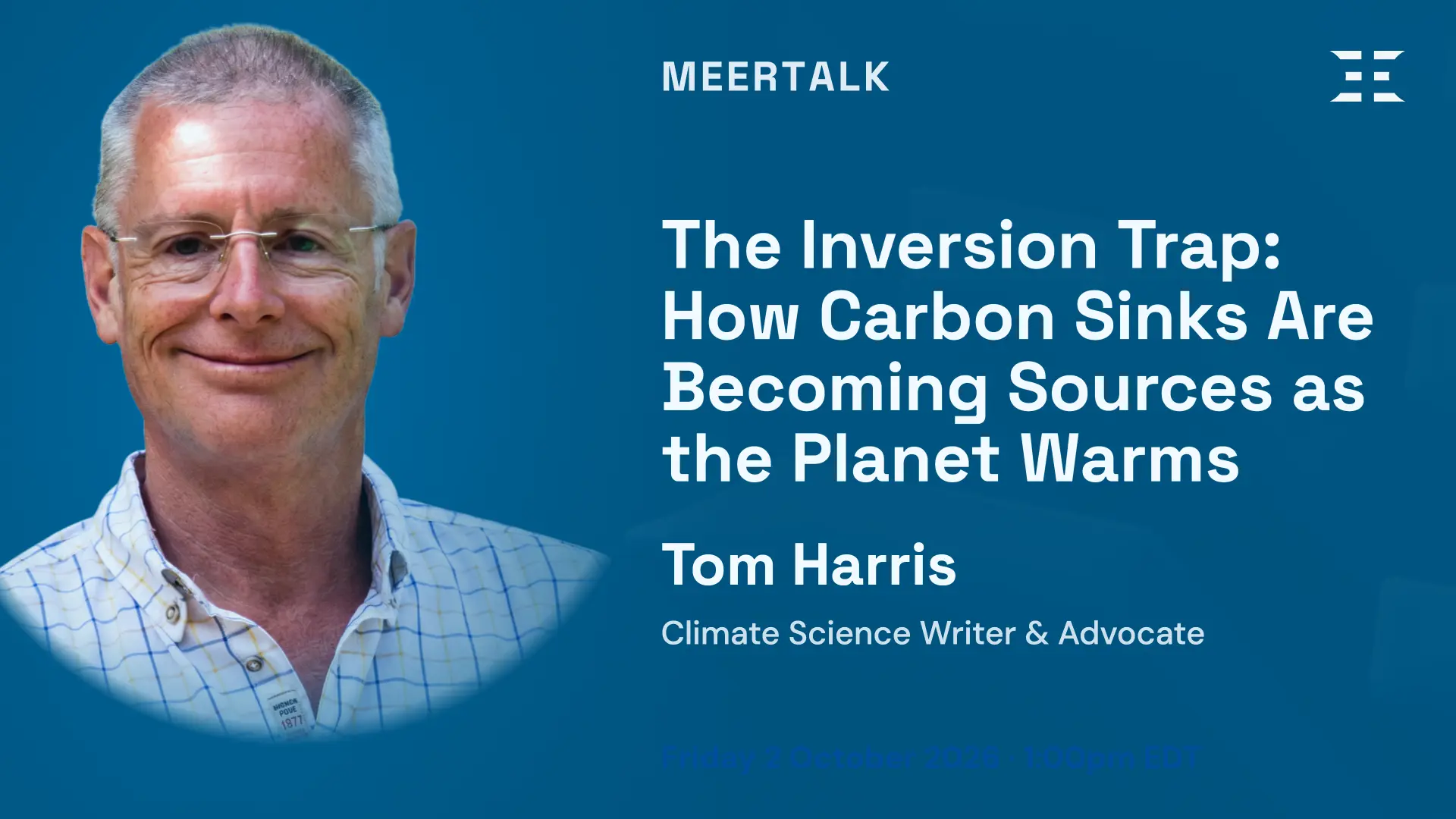
The Inversion Trap: how carbon sinks are becoming sources as the planet warms
Tom Harris explores how forests, soils and oceans are beginning to release carbon instead of absorbing it. Held 2 October 2026.
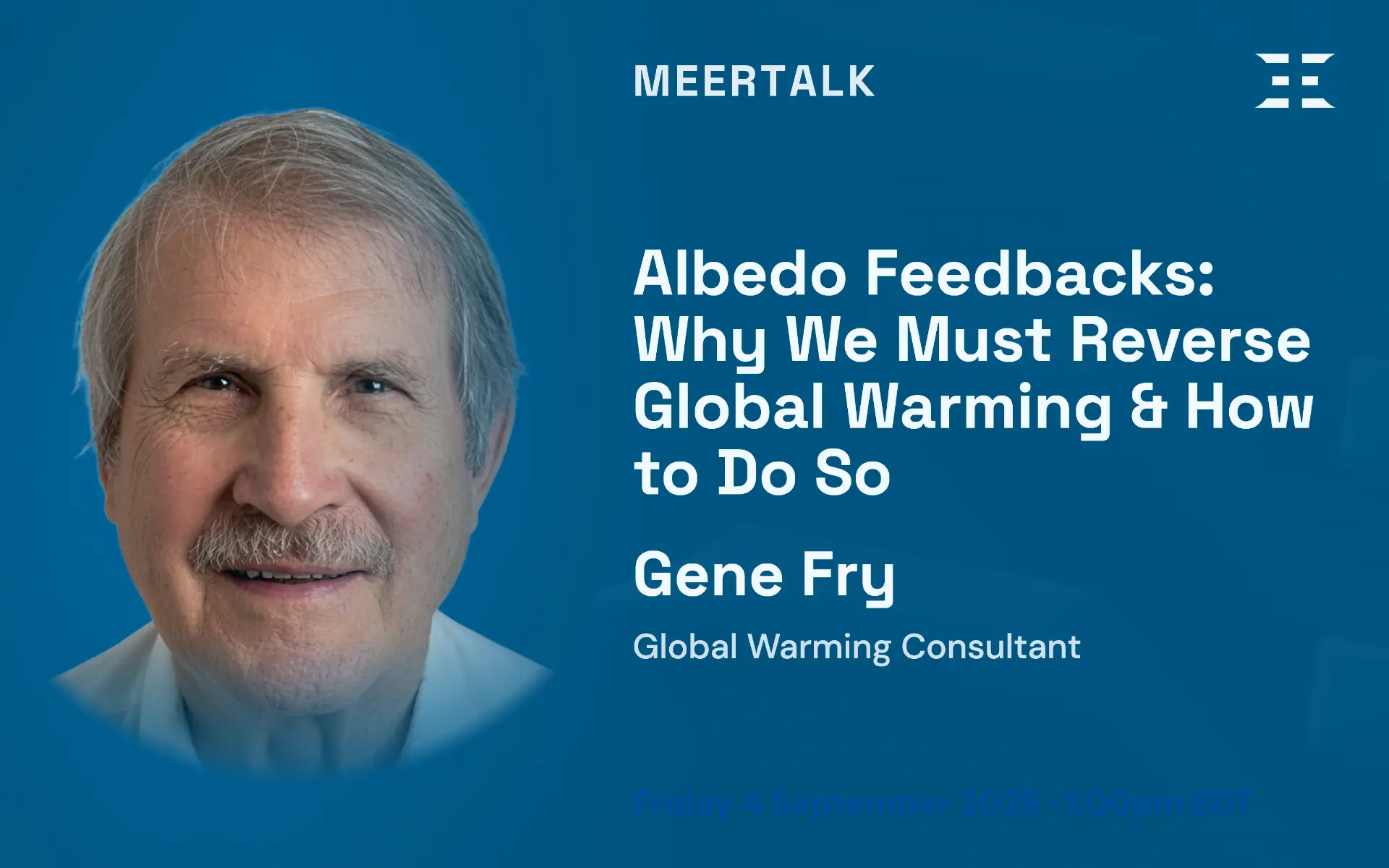
Albedo Feedbacks: Why We Must Reverse Global Warming & How to Do So
Gene Fry, Global Warming Consultant, on albedo feedbacks and why reversing global warming matters.

David Spratt – Science and the Media: Is Climate Risk Being Communicated Accurately?
David Spratt, Research Director at the Breakthrough National Centre for Climate Restoration, examines whether climate risk is being communicated accurately by science and the media.

Clare Farrell – Creative Strategies for the Climate Crisis
Creative Strategies for the Climate Crisis

Phoebe Barnard – At the Crossroads of Civilizations
At the Crossroads of Civilization: Science, Society, Wars and Personal Choice

Fred Pearce – Climate Overshoot: Is There a Way Back?
Climate Overshoot: Is There a Way Back?

Robert Tulip – Sunlight Reflection
Sunlight Reflection: The Business Case for an Albedo Accord

Dr. Luke Kemp – Goliath's Curse: Why Societies Collapse
Goliath's Curse: Why Societies Collapse

Paul Gambill – Carbon Removal Won't Scale in Time
Carbon Removal Won't Scale in Time

Dr. Jackie Kado – Climate Change and Health in Africa
Climate Change and Health in Africa: Insights from a NASAC Publication

Dr. Tarje Nissen-Meyer – Good Vibrations from the Soil
Good Vibrations from the Soil: Seismology for Ecosystem Monitoring

Robert Hunziker – Denial to Disaster: The Consequences of Ignoring Climate Science
Denial to Disaster: The Consequences of Ignoring Climate Science

Mike Tidwell – Confessions of a Climate Activist
Confessions of a Climate Activist: Clean Energy Alone Can No Longer Save Us. We Need to Study Sunlight Reflection — with Mike Tidwell.

Dr. Atousa Pirvaram – The Global Cooling Potential of Radiative Surfaces
The Global Cooling Potential of Radiative Surfaces — with Dr. Atousa Pirvaram.

Prof. Xuhui Lee – Humid Heat in Cityscapes
Humid Heat in Cityscapes: Urban Microclimates and the Role of Greenspaces — with Professor Xuhui Lee.

Dr. Thomas Ramge – Dimming the Sun: An Urgent Case for Geoengineering
Dimming the Sun: The Urgent Case for Geoengineering — with Thomas Ramge.

Dr. George Tselioudis – Earth's Warming Crisis: Fewer Clouds, More Sunlight
Fewer Clouds, More Warming: Contraction of world's storm-cloud zones adds to Earth's sunlight absorption — with Dr. George Tselioudis.

Jim Massa – Warming Waters: Ocean Dynamics and Their Role in Arctic Climate
Warming Waters: Exploring Ocean Dynamics and Their Role in Arctic Climate Change — with Jim Massa.

Jeff Goodell – The Heat Will Kill You First
The Heat Will Kill You First: Jeff Goodell discusses innovative adaptation strategies, including the radical redesign of buildings and cities.

Richard Heinberg – 7 Steps to a Real Renewable Energy Transformation

Eliot Jacobson – How Hot Is It?
How Hot Is It? How Hot Will It Get? Learn from Eliot Jacobson about the current status of the IPCC's global target of Article 2 of the 2015 Paris Agreement.

Nick Breeze – COPOUT: How Governments Have Failed the People on Climate
COPOUT: How Governments Have Failed the People on Climate — with Nick Breeze.

Jennifer Francis – Weathering the Storm: Climate Change's Impact
Weathering the Storm: Climate Change's Impact 2024 has delivered a smorgasbord of destructive and disruptive extreme weather events — with Jennifer Francis.

Vishwanath Srikantaiah – Local Water Solutions in an Era of Climate Change
Local Water Solutions in an Era of Global Warming — Vishwanath Srikantaiah discusses how communities in India are working together to build climate-adaptive solutions.

Jessica Wan – Marine Cloud Brightening in a Changing Climate
Marine Cloud Brightening in a Changing Climate — Jessica Wan's work demonstrates that regional marine cloud brightening in the North Pacific can be effective at reducing the risk of extreme heat.

John Vaillant – Fire and Oil: Rising to the Challenge of a More Flammable World
Fire and Oil: Rising to the Challenge of a More Flammable World — with John Vaillant.

Paul Maidowski – Bamboo Revolution: Social Tipping Point for Planetary Climate Migration?
Bamboo Revolution: Social Tipping Point for Planetary Climate Migration — with Paul Maidowski, who studied International Relations in Dresden.

Paul Beckwith – Global Tipping Points: The Good, the Bad and the Ugly
Global Tipping Points: The Good, the Bad and the Ugly — Learn about the negative tipping points, positive tipping points and the race for the future with Paul Beckwith.

Philippe Rahm – Climate Architecture
Climatic Architecture — Philippe Rahm speaks about how architecture can help fight against climate change.

Tim Garrett – Are Clouds a Dial We Can Use to Control Climate Change?
Are Clouds a Dial We Can Control to Mitigate Climate Change? Clouds play a controlling role in the atmosphere, in large part because of their reflectivity.

Sandy Trust – The Emperor's New Climate Scenarios
The Emperor's New Climate Scenarios — Sandy Trust explains why commonly used models in financial services are underestimating climate risk.

Herb Simmens – A New Climate Vocabulary: Communicating a Hopeful Vision for a Healthy Climate
A New Climate Vocabulary — Herb Simmens speaks about how a new climate vocabulary can bring to life a hopeful vision of a healthy and stable climate.

Dr. Peter Carter – The Rapidly Deteriorating Climate Emergency and the MEER Initiative
In the near-term, billions of the most vulnerable to climate chaos and socioeconomic stressors will be forced to migrate due to intolerable conditions — Dr. Peter Carter on the rapidly deteriorating climate emergency and the MEER initiative.

Professor Nana Klutse – Climate Change: From Science to Development and Moral Challenge
Climate change used to be a science challenge until recently, when it has also become a developmental and moral challenge — with Professor Nana Klutse.

Ronita Bardhan – Overheating Cities on a Hot Planet
Overheating Cities on a Hot Planet — a fascinating and inspiring talk centered around how to help overheating cities through urban design and inclusive planning.

Dr. Ye Tao – MEER's Short Documentary
This MEERtalk premiered MEER's short documentary FREETOWN: COOLING A CITY, featuring Dr. Ye Tao, Founder & Director of MEER, along with community partners in Sierra Leone.

Margaret Klein Salamon – Climate Emotions and Activism: A Psychologist's Perspective
Climate Emotions and Activism: A Psychologist's Perspective — with Margaret Klein Salamon, PhD, Clinical Psychologist.

Jem Bendell – Breaking Together: A Freedom-Loving Response to Collapse
Breaking Together: A Freedom-Loving Response to Collapse — with Jem Bendell, world-renowned scholar.

Thomas Goreau – Saving Coral Reefs from Extinction
MEER Is Growing — Project Expansion in Freetown! A recent huge rainstorm has damaged a municipal building in Sierra Leone. Tom Goreau on saving coral reefs from extinction.

Charlie Gardner – What's Inside the IPCC Report: "The Final Warning"
What's Inside the IPCC Report 'Final Warning'? — Charlie Gardner, Conservationist, Activist & Member of Scientists for Extinction Rebellion.

David Spratt – Faster, Higher, Hotter: Takeaways from Climate System 2022
Faster, Higher, Hotter: Takeaways from Climate 2022 — David Spratt, Research Director for Breakthrough National Centre for Climate Restoration.

Dr. Rupert Read – Transformation Beyond the Climate
Dr. Rupert Read sets out succinctly the case for building what has come to be called a new mass 'moderate' flank in climate action.

Ugochi Anyaka-Oluigbo
Environmental Degradation: Stories from the Frontlines — Ugochi Anyaka-Oluigbo, environmental journalist, speaks about degradation in Nigeria and beyond.

Gulrez Azhar – Indian Summer: Three Essays on Heatwave Vulnerability, Estimation and Adaptation
Dr. Gulrez Shah Azhar explores mechanisms to mitigate the mortality effects of heatwaves and to generate appropriate local heat action plans.

Steve Keen – The Appallingly Bad (Neoclassical) Economics of Climate Change
The Appallingly Bad Neoclassical Economics of Climate Change — Professor Steve Keen, author, economist, and Distinguished Fellow.

Kyle Kimball – The IPCC Exacerbating Climate Change
Since 1988 the IPCC has been the world's leading resource on climate change science and policy recommendations. What if they have been getting it wrong? Kyle Kimball investigates.

Simon Michaux – Mineral Supply Challenges to Phase Out Fossil Fuels
Mineral Supply Challenges to Phase Out Fossil Fuels — with Simon Michaux, Associate Professor of Geometallurgy at the Geological Survey of Finland.

MEERtalk September 2022
Facing Our Climate Anxiety Health Crisis — Britt Wray on human responses to the global climate crisis and the earth's current ecological state.

Michael Diamond – Marine Cloud Brightening: Is It Feasible?
Marine Cloud Brightening: Is It Feasible? — with Michael Diamond, CIRES (Cooperative Institute for Research In Environmental Sciences) Postdoctoral Visiting Fellow at NOAA.

Dr. Daniel Cziczo – Unanticipated Impacts of 'Designer' Aerosols for Increasing Earth's Albedo
Dr. Daniel Cziczo, Professor and Department Head of Earth, Atmospheric, and Planetary Sciences, speaks about known unknowns in Stratospheric Aerosol Injection (SAI) proposals.

Leon Simons – Sulfur Aerosols, Global Dimming and the Risk of a Warming Planet
Leon Simons presents his most recent analysis of atmospheric aerosols, how they affect the Earth's albedo (surface reflectivity), and the risk of a warming planet.

Dr. Ye Tao, Peter Dynes, Dr. Lisa Doner & Dr. Eric Hoffman – COVID Aerosols Analysis, MEER Urban & Short-Circuiting the Greenhouse Effect
Dr. Ye Tao: Covid aerosols analysis. Peter Dynes: MEER Urban. Dr. Lisa Doner and Dr. Eric Hoffman: Short-circuiting the greenhouse effect.